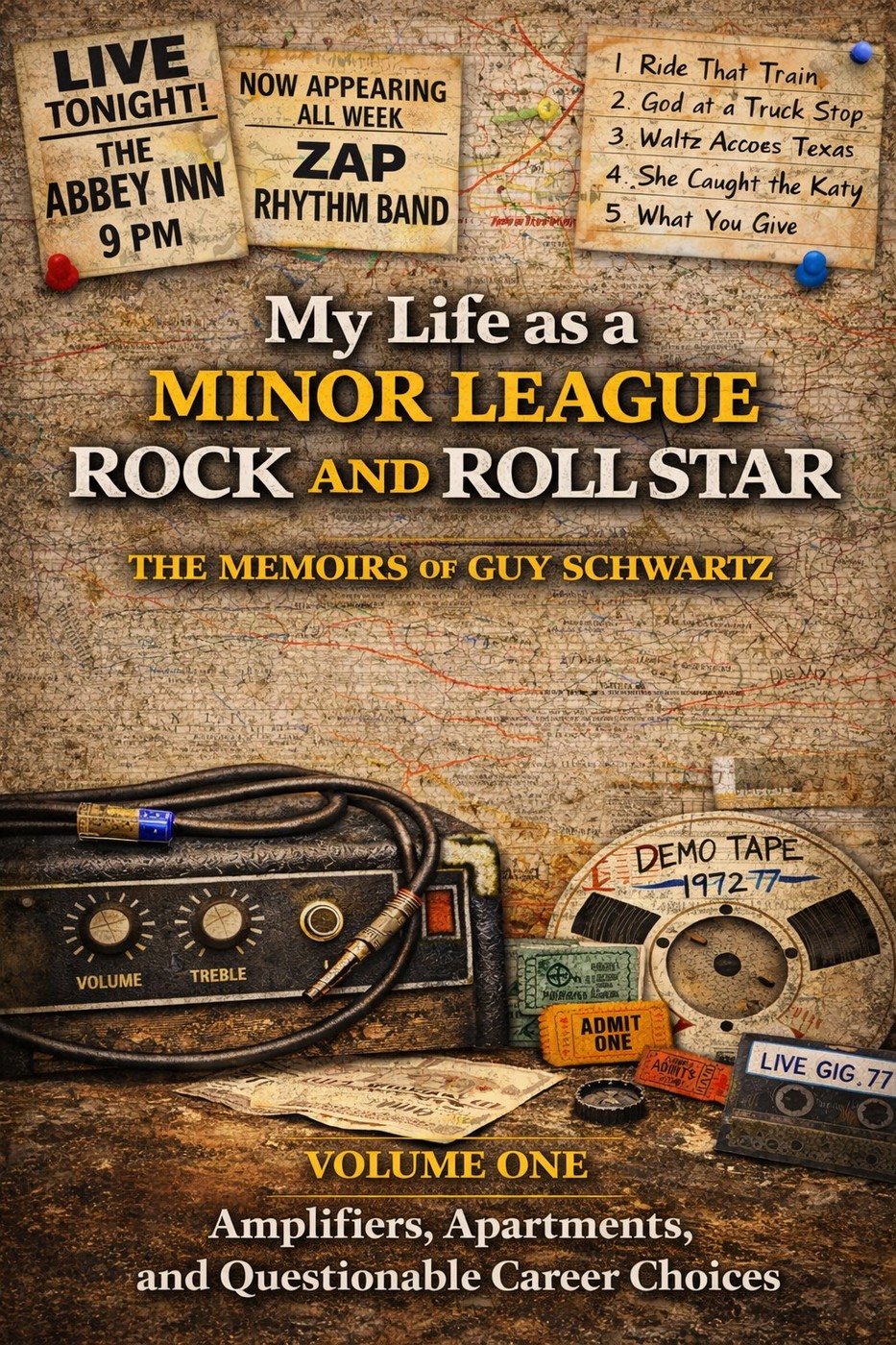
My Life as a Minor League Rock and Roll Star — Volume 1
Amplifiers, Apartments, and Questionable Career Choices.
Books
Memoirs, musical poetry, comedy, road stories and an accidental imaginary spy novel.
Amplifiers, Apartments, and Questionable Career Choices.
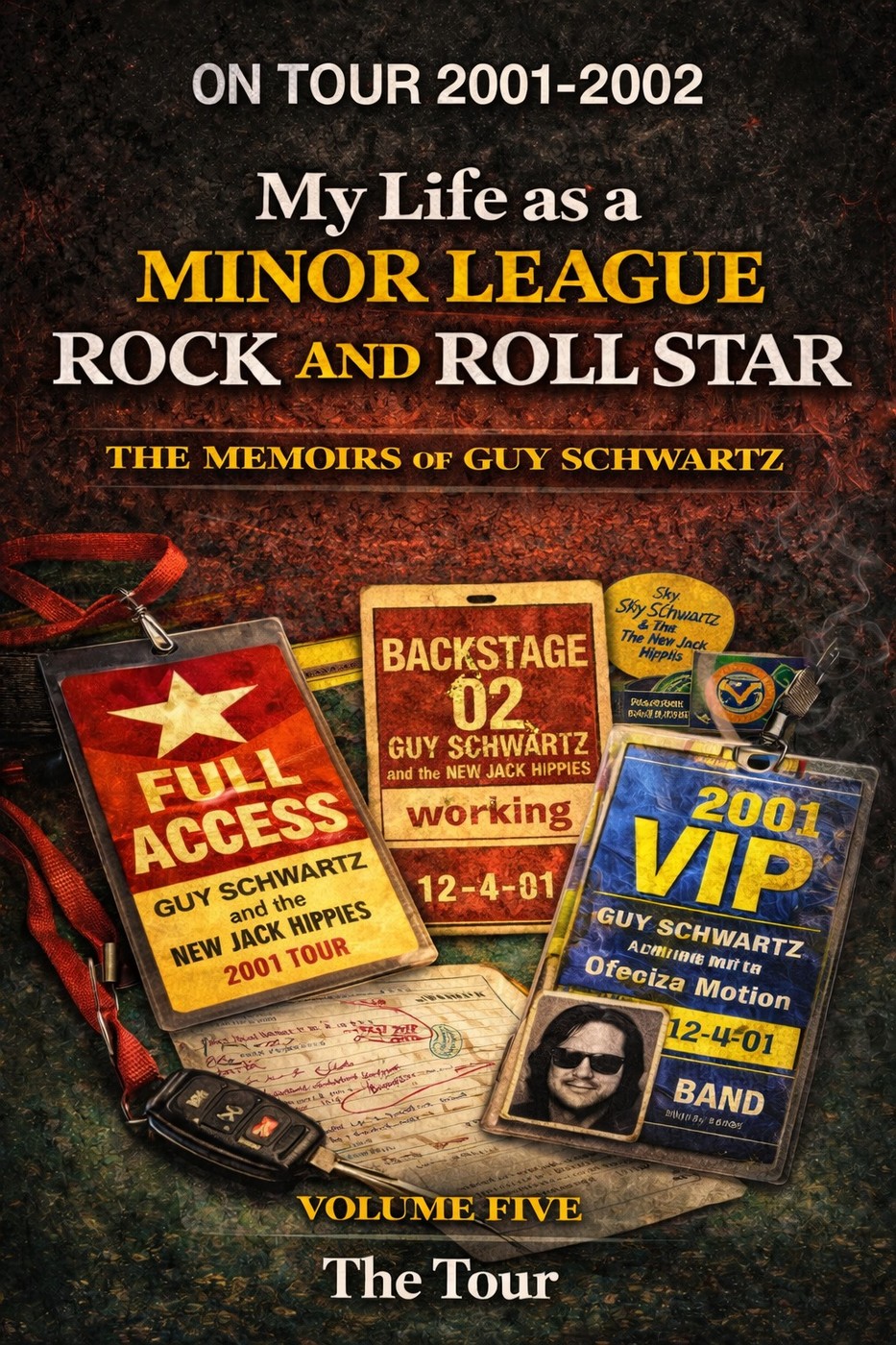
The Tour — the New Jack Hippies on the road in 2001.
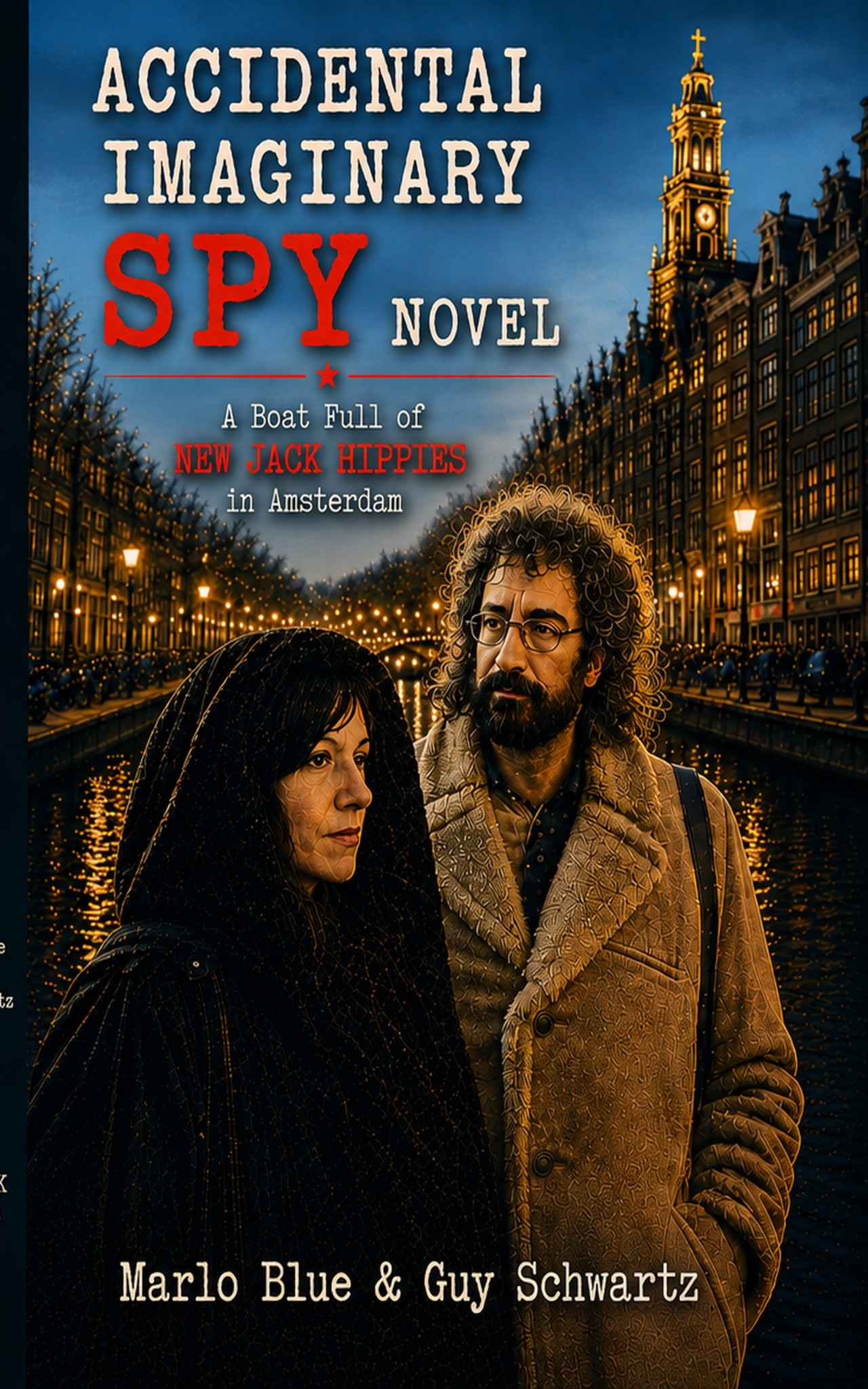
Guy’s emails and journal inside Marlo Blue’s imaginary spy framework.
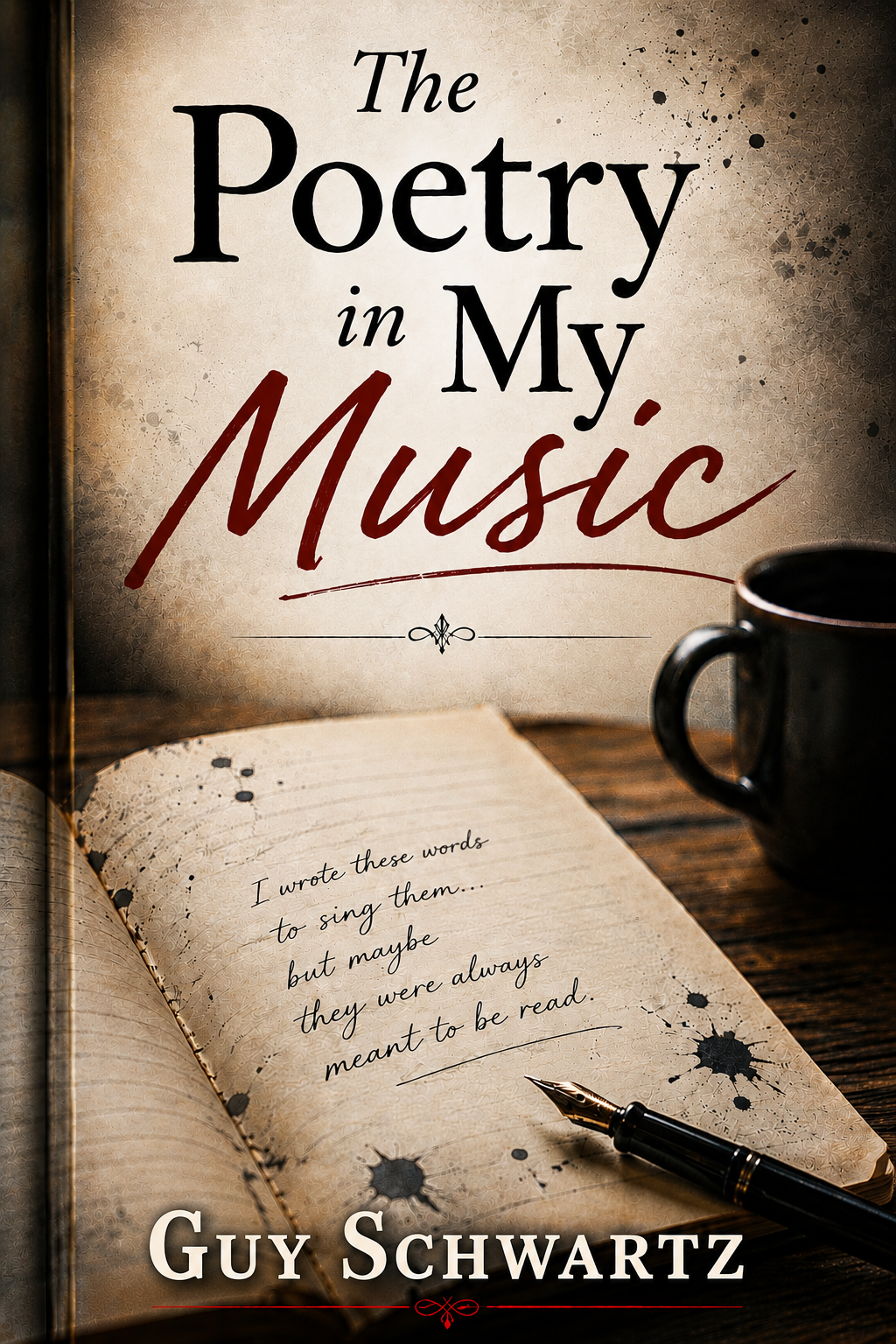
Lyrics and poems gathered as poetry, without commentary between the words and the reader.
Thank goodness the music was always there! In a family run by an alcoholic chronic gambler with anger issues and PTSD, assisted by a spoiled only child with no grip on the realities most of us are confined to, their union produced quite a litter — an international terrorist, the last of the happy-go-lucky tin men, a lifelong criminal/inmate/religious leader, and me.
Because of the trauma created therein, I didn’t remember a lot of those earliest days until therapy years later. I’m sure there are plenty of memories I don’t remember at all.
But those are stories for another book. This one is all about how I found the music, and how the music found me.
It wasn’t a conscious choice.
In the earliest of those formative days, I grew up in a house that was often loud. Sometimes noisy in a chaotic way, because four boys and a lot of anger will make a lot of noise, but sometimes, on the good days, it was more like a constant hum — the low-level buzz of the radio, conversation, laughter, road stories, and musical lessons taught by a diversely musical group of characters. Music wasn’t an activity in our house. It was the air.
At first, it was just me and a housekeeper. Mom was always doing something social, and Dad was working (whatever that meant on any given day). Soon, the three slightly younger brothers arrived, and the place tipped fully into controlled chaos.
At times, our house didn’t feel like a family home so much as an ongoing hostel and rehearsal space that occasionally shut down for meals. Musicians didn’t just stop by. If they were passing through town, they slept on the couch. They sat at the kitchen table while my mother or the housekeeper made breakfast or lunch, talking about last night’s gig, the next town, or some record they were chasing. Plates clattered. Coffee cups refilled. Someone always seemed to be tapping out a rhythm on the table, whether anyone wanted to hear it or not.
Mom was usually at home and happy on those days, forgoing her golf or mah jong. Dad was never angry on those days. They loved those musicians and loved paying attention to them. It wasn’t until many years later that I realized my desire for some of that attention may have pointed me to a life of music, too.
Even at four or five, I could feel it. The house breathed music. Notes weren’t played or sung — they were passed around, corrected, argued over, laughed about. I watched musicians unpack their road lives into our living room, cases leaning against the wall like suitcases from another world. They taught me without trying. They showed me how music worked as a language, a job, a calling, and sometimes a problem.
I didn’t know it then, but I was being raised in something rare: a household where music wasn’t treated like entertainment. It was treated like language. Like food. Like truth.
And one of the strangest parts of it all is that none of it felt strange at the time.
Sometimes, on party nights, one of the visitors would put me to bed. Billy Eckstine stood over my crib and told me that, “Aces beat Kings, Kings beat Queens, Queens beat Jacks…” Ella Fitzgerald sang me a lullaby. The grown-ups kept the music going downstairs until the Redd Foxx records came out.
Years later, my parents showed me a photograph of me sound asleep on Ella’s lap at a Harlem jam session at two or three in the morning. I don’t remember the moment itself. But I remember the photograph.
That picture was lost in the fire at my parents’ house when I was fourteen. Along with it went most of the memorabilia from those early years — my bass, my pleated Naugahyde-covered Kustom bass amp, cables, and little pieces of proof that it all really happened.
Kustom was a new company then, spelled K-U-S-T-O-M, and their big innovation was those padded, pleated Naugahyde coverings instead of the standard tolex glued onto wood like shelf paper. The joke going around musician circles was always, “What’s a Nauga?” or “How many Naugas did they have to kill?” Of course, there is no such animal.
When you’re a kid, your baseline reality is whatever surrounds you.
In my world, the adults around me weren’t just businessmen and neighbors and relatives. They were artists. Sometimes famous ones. Sometimes almost-famous ones. Sometimes people who could’ve been famous but never quite got the break. But all of them carried that same quality I came to recognize later as the real thing — the spark of someone who had no choice but to do music.
The records in our house told a story too. My parents listened to swing and bebop for the most part. Dad was digging on that new Boogie Woogie. Later, when we moved to Texas, my dad tried Country & Western for a while, like a man trying on a new hat to see if it would fit his head and his new life.
But in those earliest years, there was jazz.
My dad had favorite songs that stuck in my brain like tattoos: Billie Holiday singing “God Bless the Child,” Wynonie Harris with “Don’t Roll Those Bloodshot Eyes at Me.” When it came to party time, my mother sang the blues along with Dinah Washington records. They were part of the family conversation.
If you listen long enough to that kind of music as a kid, if it’s in your air like oxygen, it doesn’t matter what kind of musician you later claim to be. You’re already carrying a certain rhythm in your bones.
I didn’t know the word “influence” yet.
I just knew what the house sounded like.
And when I eventually went chasing rock and roll, I carried all of that with me, even when I tried not to.
In the middle of it all was my family, feeding people, making room, keeping the lights on. Music wasn’t something I discovered later.
It was something I was born into.